Is the Tube Era Over? Why Deep Purple's Simon McBride Swapped Classic Amps for a Digital Modeller Quad Cortex
One after another, even the most uncompromising tone purists seem to be changing their minds. Legendary rock veterans—who have traditionally favored glowing vacuum tubes over modern computer microchips—are increasingly experimenting with digital amp modellers, only to find themselves utterly blown away by the sonic results.
Take the iconic Joe Bonamassa as a perfect example. The blues virtuoso is world-renowned for his massive collection of vintage instruments and rare equipment, housing them in two spectacular museum-grade locations: Nerdville East in Nashville and Nerdville West in Los Angeles. Yet, even this ultimate gear connoisseur recently shocked the community by revealing a partial transition to digital, having integrated Fender Tone Master amplifiers into his touring setup.
The guitarist admitted last month that upon first plugging into the unit, he immediately realized just how incredibly good the technology had become. Joe Bonamassa confessed he had actively wanted to dislike the digital gear, but its sheer performance made that impossible. He also noted that he was fully prepared to face a wave of backlash from traditionalists for embracing digital modelling technology.
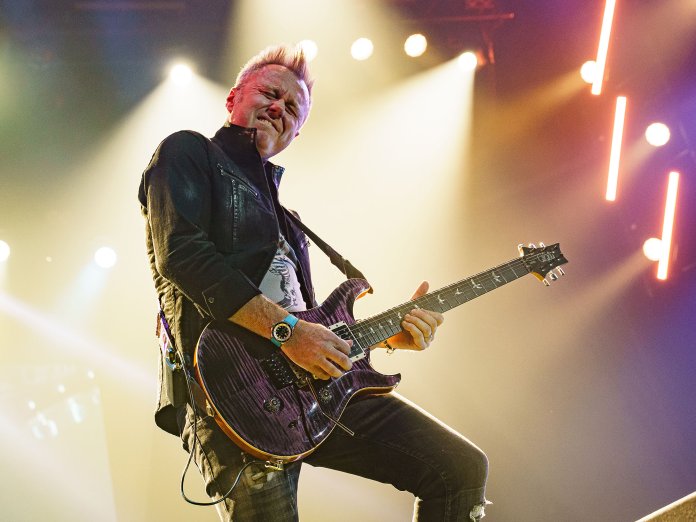
Now, Deep Purple's brilliant guitarist Simon McBride has taken a similar path. Just like his blues counterpart, he is well aware of the potential criticism from hard-core fans.
In a recent conversation with Guitarist magazine, the musician shared that while he owns an impressive collection of traditional amplifiers, his primary touring rig for his work with Deep Purple is now centered around the Neural DSP Quad Cortex. He jokingly remarked that he can almost hear the cries of devout Ritchie Blackmore disciples lamenting his choice to go digital, though he maintains that the unit is absolutely stellar.
The shift to using the Neural DSP Quad Cortex in 2025 was primarily driven by a practical need to optimize and streamline his live performance setup.
In addition, the guitarist had to solve a complex sonic puzzle on stage. He had to adjust his tone to complement keyboardist Don Airey, who performs using a legendary Hammond organ and Leslie rotary cabinet run through a powerful Marshall head and speaker system. Simon McBride explains that because the organ operates in a very similar frequency spectrum to his guitar, he had to find a creative way to make his instrument cut through and sound immensely powerful.
As reported by Guitar World, the guitarist had previously collaborated with Engl—the prominent manufacturer behind Steve Morse’s signature amplifier, who also supplied Simon McBride with his personal Artist Edition head. He requested that the company modify the amplifier to grant him more sonic presence in distinct frequency ranges.
Specifically, he asked the engineers at Engl to restructure the amp's voicing, pushing significantly more power into the low-end and lower-mid frequencies. Knowing that the Hammond and Leslie setup lacked energy in that particular area, he recognized it as the perfect sonic window for his guitar to dominate, ensuring his tone remained massive and clear during unison riffs.
While the musician did not state it outright, Guitar World points out that his customized Engl amplifier has almost certainly been profiled, captured, and loaded directly into his Neural DSP Quad Cortex.
This transition to digital modelling setups is rapidly becoming the standard among elite guitar players, with other legendary names like Metallica's James Hetfield, solo artist Nita Strauss, and Pearl Jam's Mike McCready all relying on modern modellers for their world-class live tones.