The Secret Weapon Behind the Wall of Sound: How a $20 Budget Speaker Box Shaped Metallica’s Legendary Black Album Guitar Tone
When musicians and tone purists picture the iconic electric guitar sounds that defined the biggest records in rock history, budget consumer electronics are certainly not the first tools that come to mind. Yet a compact, unassuming consumer device created by SRS called The WOW Thing completely shattered expectations, proving that monumental guitar tones can emerge from the most unexpected gear.
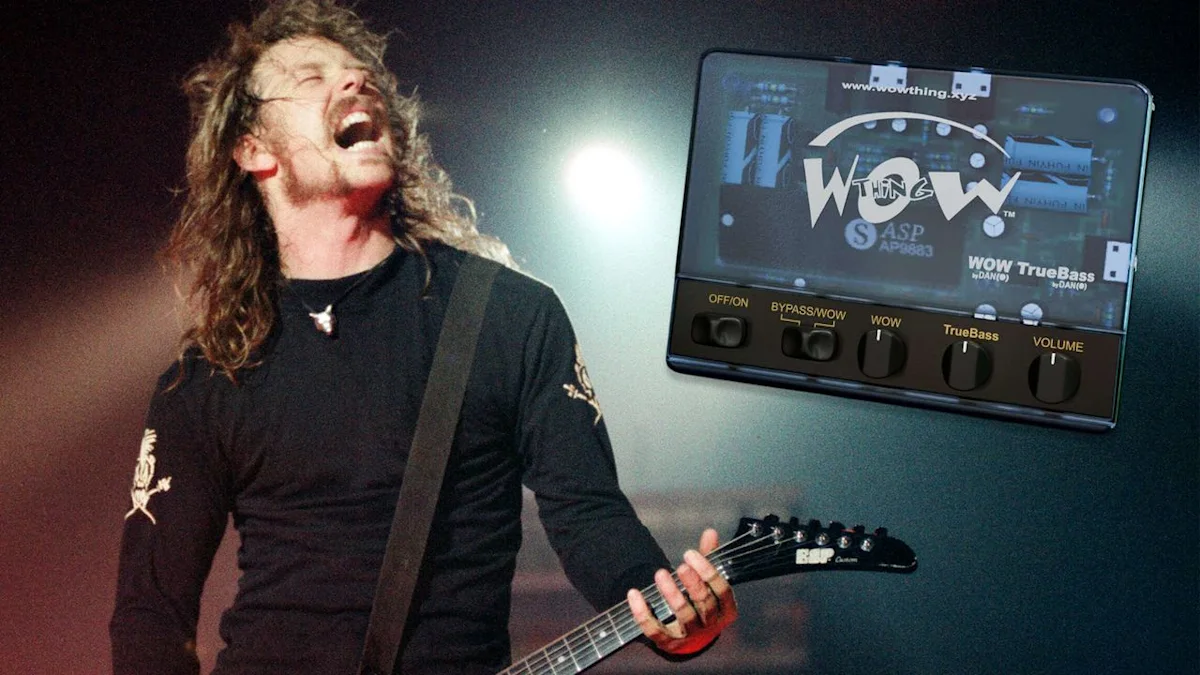
This is the story of how an eccentric, budget-friendly spatial effects processor designed strictly for home audio playback evolved into a high-end studio secret weapon—famously dubbed "the little plastic box that makes guitars sound massive."
The Origins of SRS Labs
The story began in the early 1980s when SRS (Sound Retrieval Systems) was established as an advanced psychoacoustic research branch of Hughes Aircraft. Their primary mission was to engineer a breakthrough processing system capable of extracting a realistic, three-dimensional soundstage from standard stereo audio.
By the 1990s, following an acquisition and rebranding into SRS Labs, the company launched several consumer-focused hardware products. Among them was a tiny desktop unit packed with acoustic magic: The WOW Thing. This affordable box was engineered with a humble purpose—to make cheap computer speakers sound full, spacious, and punchy.
On paper, no professional recording engineer or producer should have paid any attention to it. However, a top-tier mix engineer working on what would become one of the best-selling heavy metal records of all time accidentally discovered its true capabilities, releasing a studio secret that revolutionized guitar mixing.
Psychoacoustic Technology & Sonic Architecture
The WOW Thing generates its signature sound through a precise combination of aggressive equalization, advanced psychoacoustic algorithms, and strategic phase delays. This combination dramatically widens the stereo field while enhancing low-end punch.
The hardware is powered by three core proprietary technologies:
-
SRS 3D: expands the stereo image far beyond physical speaker placement.
-
Focus: originally engineered for automotive sound systems where speakers sit below ear level, this parameter visually "elevates" the soundstage vertically.
-
TruBass: designed to give small speaker cones a massive presence, this algorithm utilizes psychoacoustic bass enhancement to generate a deeper, natural low end.
The unit executes frequency moves that closely mirror traditional electric guitar mixing techniques: pumping up the low-end fundamental, scooping out muddy low-mid frequencies, and adding a subtle high-end presence boost. While these processing moves are routinely executed today via software plugins, this hardware approach was completely game-changing in the early 1990s.
The Studio Discovery
"Wider, brighter, and absolutely massive"—that is how acclaimed mix engineer Randy Staub (known for his work with Metallica, Mötley Crüe, and U2) described the effect of The WOW Thing on distorted electric guitars. He stumbled upon the software processing version while listening to audio on his home computer and immediately realized its potential on heavy guitar tracks: tighter bass response, an airy top end, and a gentle low-mid scoop that allowed guitars to sit effortlessly in a dense mix.
At the time, Randy Staub was actively mixing Metallica's legendary Black Album and searching for a way to make the rhythm guitars played by James Hetfield and Kirk Hammett sound wider and more commanding. The WOW Thing provided the exact secret sauce he needed.
In an interview with Ultimate Guitar, Randy Staub revealed: "I started using the WOW Thing on guitars to spread them out in the stereo image, and that's what I've been using for years and years."
Integrating The WOW Thing into the Mix
Beyond spatial widening, Randy Staub dialed in the unit to boost low-end punch, inject top-end presence, and scoop out conflicting mid-range frequencies. This gave the rhythm guitars immense weight while creating clear separation from the lead vocals and snare drum, which typically compete in the exact same frequency space.
The WOW Thing offered a fresh way to make double-tracked rhythm guitars sound larger-than-life, bypassing traditional EQ and compression methods previously used to create separation between guitar layers.
Because the unit was designed for stereo signals, Randy Staub ran panned pairs of guitar tracks and stereo guitar buses directly through the processor. The result was a thick, razor-sharp, and massive guitar tone that remains a benchmark for rock production 35 years later.
Modern Re-creation: The Korneff Audio Plugin
Eventually, premier engineer Dan Korneff (noted for his work with Breaking Benjamin, Papa Roach, My Chemical Romance, and Paramore) learned about the hardware unit and began incorporating it into his own mixes before deciding to model it into a dedicated digital plugin. "This happy accident completely changed what we thought was possible for electric guitars," Dan Korneff explained. "Instantly, you hear the guitars get wider, deeper, and more immersive."
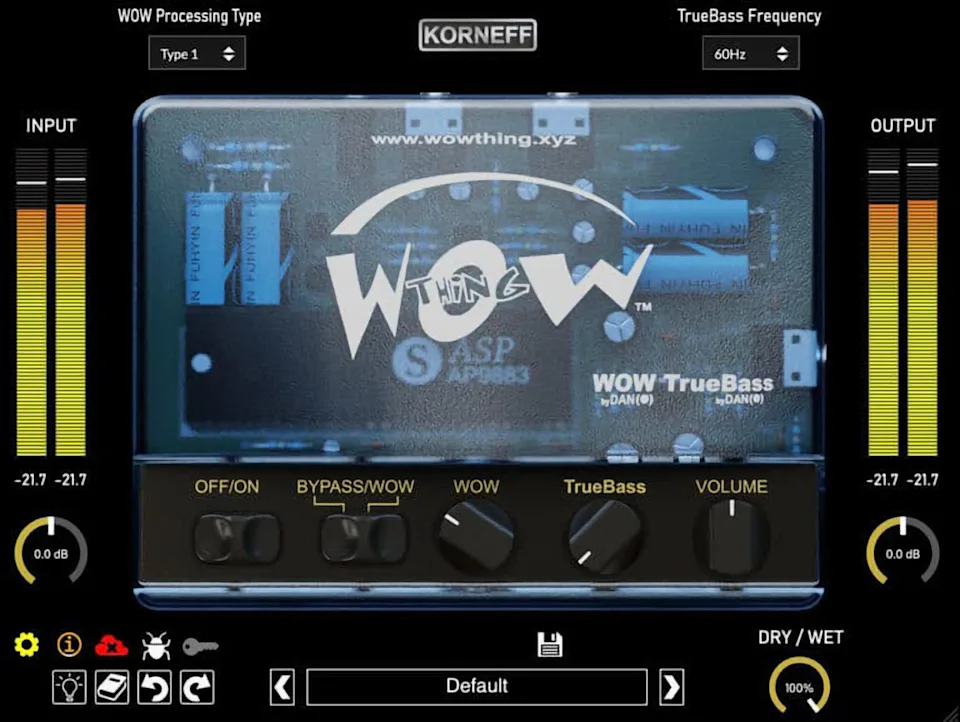
As news of The WOW Thing spread throughout the audio community, original hardware units became increasingly rare. Korneff Audio, founded in 2019, built a digital plugin that meticulously models the original hardware's circuit and GUI while adding modern functionality for both mono and stereo workflows.
Under the hood, the plugin features adjustable frequency centers for the TrueBass control (ranging from 40Hz to 400Hz), two distinct spatial processing modes (emulating both the desktop box and the Megawide rackmount hardware), a Blend knob for parallel processing, and a low-end mono switch to ensure maximum stereo width without phase cancellation.
The TrueBass control adds low-end weight, making it an exceptional tool for downtuned, extended-range 7-string and 8-string electric guitars. It works equally well on master guitar buses. Additionally, a TrueBass Dynamics switch engages a four-band frequency-dependent compressor for precise low-end control.
Reflecting on why he brought the plugin to market, Dan Korneff stated: "I wanted my guitars to sound as massive as Randy Staub's. This plugin delivers all of that and more—it makes your guitars feel like they're giving you a giant bear hug."
The Power of Studio Experimentation
The history of record production has always favored out-of-the-box thinking and unconventional methods. It remains remarkable that a $20 consumer gadget originally built for computer speakers transformed into a legendary studio secret weapon that shaped some of the greatest rock albums ever recorded.
The lasting impact of The WOW Thing on modern mixing proves that the price or intended purpose of a gear tool matters far less than the creativity of the musician and engineer behind the board.