Angine de Poitrine: Decoding the Notes Between the Notes: Microtonal Guitar
With sonic explorers Angine de Poitrine kicking off their sold-out US tour, the guitar world's most viral duo has once again sparked a global conversation around their mind-bending microtonal guitar tones. Alongside King Gizzard & The Lizard Wizard, they are completely reshaping what modern guitarists can achieve by integrating microtones into rock music.

Beyond diving into the gear itself, this comprehensive guide covers everything you need to know about microtonal music. We will take a journey through the history of music, explore the underlying mathematics, and unpack why microtonal guitars sound so intriguing and unconventional to the Western ear. By the end of this article, you will not only gain a solid understanding of music theory but also expand your mindset far beyond the traditional frets of a standard electric guitar.
Understanding 12-TET and Standard Guitar Construction
Let's begin with standard guitar tuning. Western music is built upon the 12-tone equal temperament system (12-TET). On a standard electric guitar—such as those made by Fender, Gibson, or Ibanez—you experience this system by playing every note in sequence from the open string up to the 12th fret on the low E string. That sequence covers all 12 notes of the 12-TET framework, which forms the foundation of virtually every major pop, rock, blues, funk, or heavy metal track ever written.
However, these 12 notes do not represent the entirety of musical sound. They are simply the specific set of pitches Western music adopted through the widespread implementation of the 12-TET system.
Countless notes exist in the spaces between those 12 core tones. Think of it like a color wheel: while red, blue, and yellow serve as primary anchors, infinite shades exist in between to paint a picture.
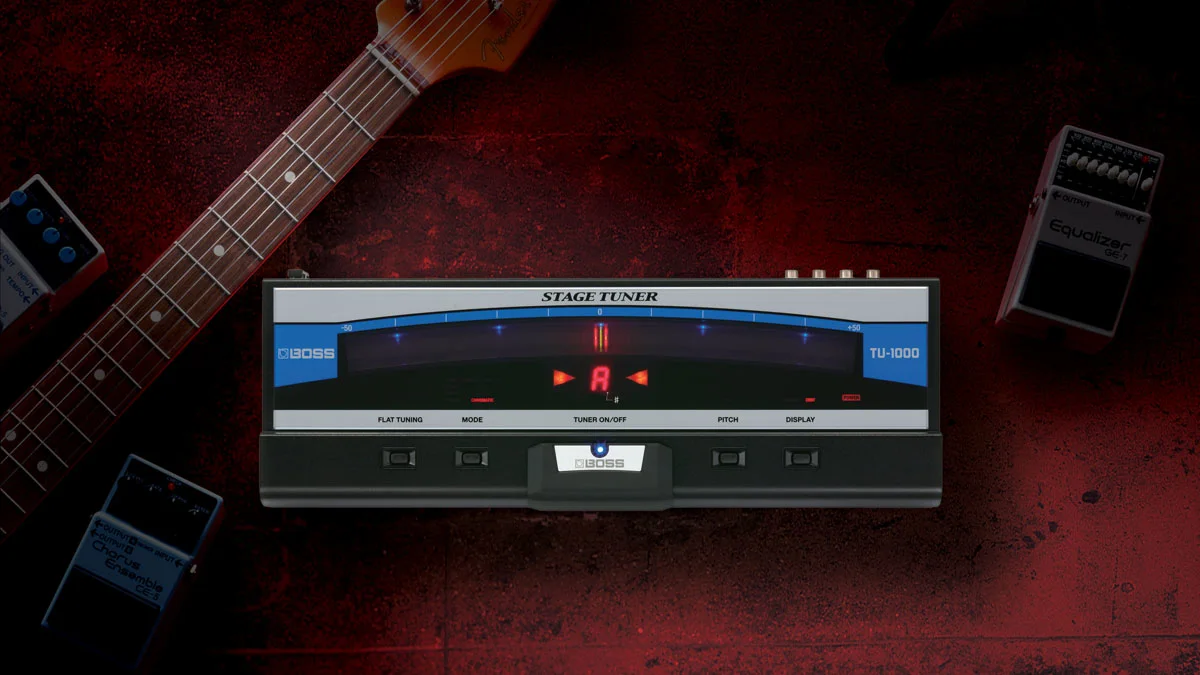
To simplify the mathematical concept, it is helpful to measure notes in cents rather than frequency (Hz). If you have ever used a digital guitar tuner, you are already familiar with cents. Cents represent pitch increments: there are 100 cents per fret interval on a guitar neck, 1,200 cents in a full octave, and 50 cents in the quarter tones currently utilized by bands like King Gizzard and Angine de Poitrine.
The Notes Between the Notes
In nature, sound does not naturally divide into rigid steps; it flows continuously as a rising or falling pitch. Technically speaking, an infinite number of pitches exist. While human ears cannot distinguish every minute shift, a trained ear can perceive approximately 240 distinct pitch changes within a single octave—an accuracy of roughly 5 cents. This perception varies across the frequency spectrum, as human hearing is most sensitive in the midrange and less precise at extreme low or high frequencies.
In microtonal music, players utilize the spaces between the standard 12 tones. Bands like Angine de Poitrine and King Gizzard play guitars fitted with extra frets to access smaller intervals called quarter tones, unlocking sounds that cannot be produced on a standard neck. Where a standard guitar neck features 12 frets per octave, a microtonal neck can feature 24.
Consider this in terms of cents: an open string represents 0 cents, the 3rd fret represents 300 cents, and the 4th fret represents 400 cents. A quarter tone placed between them sits at 350 cents. This interval rests precisely halfway between a major and minor third, sounding unresolved or "exotic" to a Western listener accustomed to 12-TET. For Middle Eastern or Indian musicians, however, these in-between notes have formed the core of musical expression for thousands of years.
History: How Western Music Shifted Away from Microtones
Microtonal music is not a modern anomaly; for most of human history, microtonal music was simply music. When humans first sang, blew through carved bone flutes, or plucked animal-gut strings, no artificial tuning systems existed. Sound was an aspect of the natural world, and instruments were developed to mimic it.
Musicologists reconstructing one of the oldest known melodies in human history from Babylonian tablets revealed a musical structure based on tuning in fifths.
To understand modern microtonal guitar playing, it is essential to trace how Western music gradually standardized into the 12-TET system. This evolution relies heavily on acoustics and mathematics.
The Pythagorean Comma
Legend holds that Pythagoras first mapped the mathematical foundations of musical tuning around 500 BCE using a monochord—a single string stretched over a wooden board with a movable bridge. By adjusting the bridge, he discovered that dividing a vibrating string into simple integer ratios produced harmonious intervals.
You can observe this directly on any acoustic or electric guitar:
-
Dividing the total vibrating string length exactly in half ($1/2$) produces an octave at the 12th fret.
-
Dividing the string length into thirds ($2/3$) leaves two-thirds vibrating, producing a perfect fifth at the 7th fret.
These node points represent natural acoustic sweet spots where natural harmonics ring out clearly.
Under Pythagorean tuning, stacking 12 consecutive perfect fifths should theoretically land on the exact same note as moving up 7 octaves. However, during the Renaissance and Baroque periods, as keyboard instruments like organs and harpsichords gained prominence, composers began writing complex multi-part harmonies that exposed a fundamental mathematical discrepancy in pure fifth tuning.
The mathematical conflict breaks down as follows:
-
Moving up 7 octaves: An octave measures 1,200 cents. Stacking 7 octaves ($7 \times 1,200$) yields 8,400 cents.
-
Moving up 12 Pythagorean perfect fifths: A pure fifth measures 701.955 cents. Stacking 12 pure fifths ($12 \times 701.955$) yields 8,423.46 cents.
This difference of approximately 23.46 cents—nearly a quarter of a fret—is easily audible to the human ear. Because it compares multiples of even numbers against odd numbers, the two mathematical paths never align perfectly.
This disparity is known as the Pythagorean Comma. Instruments tuned to mathematically pure fifths eventually overshoot the octave, resulting in dissonant chords in certain keys. Western instrument builders spent centuries searching for a practical solution.
Two Global Approaches to Tuning
As musical compositions grew more intricate worldwide, different cultures addressed the limitations of pure interval tuning in unique ways.
India and the 22 Shrutis
In ancient India, theorists mapped the octave into 22 distinct microtonal intervals known as shrutis between 200 BCE and 200 CE, as documented in the foundational treatise Natya Shastra.
A prime example among stringed instruments is the veena, a relative of the sitar. Unlike Western fretted instruments with fixed metal frets, the frets on a veena were tied with cord or secured with wax. Players could adjust fret positions along the neck to accommodate specific microtonal scales (ragas). Furthermore, the arched metal frets sat elevated above a curved neck, allowing players to pull strings downward to bend pitches by up to five semitones from a single fret position.
The Middle East and the Maqam
In Middle Eastern musical traditions, musicians developed the maqam system during the Islamic Golden Age while translating ancient Greek mathematical texts. A maqam is not merely a scale, but a modal framework specifying melodic pathways, emphasis notes, and microtonal intonation.
Persian musician Safi al-Din al-Urmawi tackled the Pythagorean Comma by continuing to stack perfect fifths, establishing a 17-tone system across the octave. To navigate these microsteps, musicians relied on fretless instruments like the oud, as well as fretted instruments like the baglama (or saz). In this 17-tone system, a whole step was divided into three unequal micro-steps measuring approximately 90 cents, 90 cents, and 24 cents—a structure that remains influential in Turkish folk music today.
The Evolution of the Oud into the Modern Guitar
The oud, originating around the 8th century, was traditionally a fretless instrument designed to execute the subtle microtones, vibrato, and slides of the maqam system.
Following the Moorish conquest of Hispania starting in 711 CE, the oud was introduced to Western Europe. European musicians embraced the instrument but sought to play complex polyphonic chords. Because maintaining accurate intonation across multiple voices on a fretless board is exceptionally difficult, European luthiers tied thick pieces of gut string around the neck to create fixed frets.
While fixed frets made chordal playing easy, they eliminated the instrument's native microtonal flexibility. The Arabic name al-'ud evolved into the Spanish laúd, French luth, and English lute.
To address the lute's delicate rounded body—which made standing performances and hard strumming difficult—instrument makers flattened the back and narrowed the waist, creating the precursor to modern acoustic instruments: the vihuela and Baroque guitar. Over time, tied gut frets were replaced with permanent metal fretwire, and course-grouped strings transitioned into the standard six-single-string layout used today.
The Standardization of 12-TET
The 12-tone equal temperament system (12-TET) provided the definitive Western solution to the Pythagorean Comma. By dividing the 1,200-cent octave into 12 mathematically equal steps of 100 cents each, luthiers created a neck where every fret is spaced equally in pitch.
In 12-TET, the perfect fifth on the 7th fret is tempered slightly to 700 cents (compared to the pure Pythagorean 701.955 cents). Because a 2-cent difference is virtually imperceptible to most listeners, chords sound balanced across all keys. Stacking 12 tempered fifths ($12 \times 700$) equals exactly 8,400 cents, aligning perfectly with 7 octaves.
The Convergence of Cultural Traditions
In the 19th century, Middle Eastern music theorists standardized notation by adopting a 24-tone equal temperament system (24-TET), dividing the octave into 24 equal 50-cent quarter tones to bridge traditional maqam performance with Western notation systems.
Concurrently in Spain, Antonio de Torres Jurado revolutionized guitar construction by enlarging the body, refining internal fan bracing, and establishing the standard 650 mm (25.6") scale length. This solidified the 12-TET system as the standard configuration for modern classical and steel-string acoustic guitars.
By the 20th century, avant-garde composers began breaking away from 12-TET. Julian Carrillo designed custom microtonal guitars and harps for his Sonido 13 theory; Alois Hába commissioned quarter-tone pianos in Czechia; Harry Partch developed a 43-tone just intonation system; and Wendy Carlos utilized custom microtonal synthesis scales on her 1986 album Beauty in the Beast. In Turkey, classical guitarist Tolgahan Çoğulu invented the adjustable microtonal guitar, featuring movable frets fitted into slotted channels on the fingerboard.
Around 2014, Stu Mackenzie of King Gizzard & The Lizard Wizard acquired a Turkish baglama. Inspired by its microtonal capabilities, he commissioned a custom build combining an electric guitar with baglama fret placement, producing the famous "Flying Microtonal Banana." The band subsequently modified multiple budget guitars with additional frets, resulting in a series of full-length microtonal studio albums.
More recently, Canadian duo Angine de Poitrine brought microtonal rock further into the spotlight. Utilizing a double-necked microtonal guitar, custom-placed frets, and a Boss looper pedal, they have introduced microtonal guitar playing to a new generation of listeners.
Practical Ways to Explore Microtones on a Standard Guitar
Guitarists interested in experimenting with microtonal sounds without purchasing a dedicated instrument can utilize several accessible techniques:
-
Quarter-Tone Bending: The classic blues bend—pulling a string up by approximately 50 cents between standard frets—is a fundamental microtonal technique.
-
Slide Guitar: Using a glass or metal slide turns any guitar into a fretless instrument, allowing seamless access to all microtonal pitches along the string.
-
Single-String Retuning: Lowering one or two strings by 50 cents (a quarter tone) using a digital tuner allows players to execute microtonal riffs using standard fingering shapes.
-
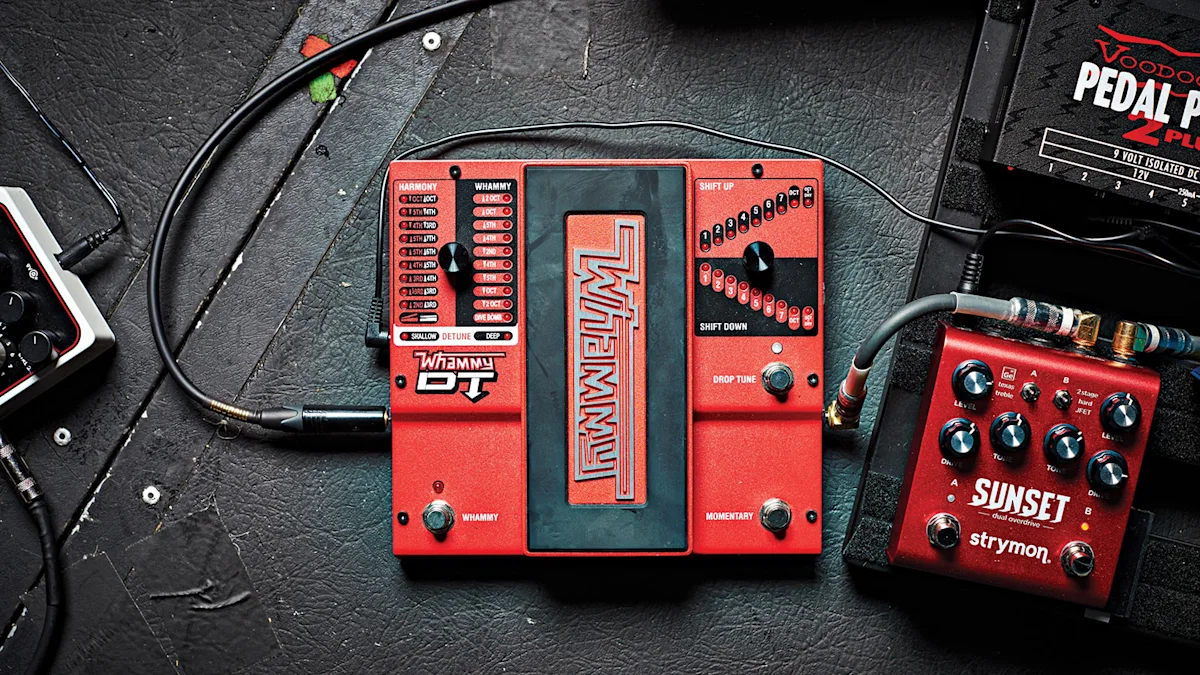
Pitch Shifter Pedals: Expression-controlled pitch pedals—such as the DigiTech Whammy, EHX Pitch Fork, or Boss PS-6—enable real-time continuous pitch bending across microtonal intervals.
-
Aftermarket Microtonal Necks: Manufacturers like Eastman Guitars and custom luthiers on platforms like Etsy (such as JLJInstruments) produce bolt-on microtonal necks designed to fit standard guitar bodies. Any skilled luthier can also retrofit a standard neck by installing additional fretwire between existing frets.