Decoding the '54 Holy Grail: First-Year Fender Stratocasters – and How Two 1954 Models Can Be Worlds Apart
The first of these two historic 1954 Fender Stratocaster models is dated March 1954, featuring serial number "0108" stamped directly onto the rear tremolo cavity cover. Industry lore suggests that early Stratocaster builds with serial numbers on the backplate were produced specifically as salesman evaluation samples.
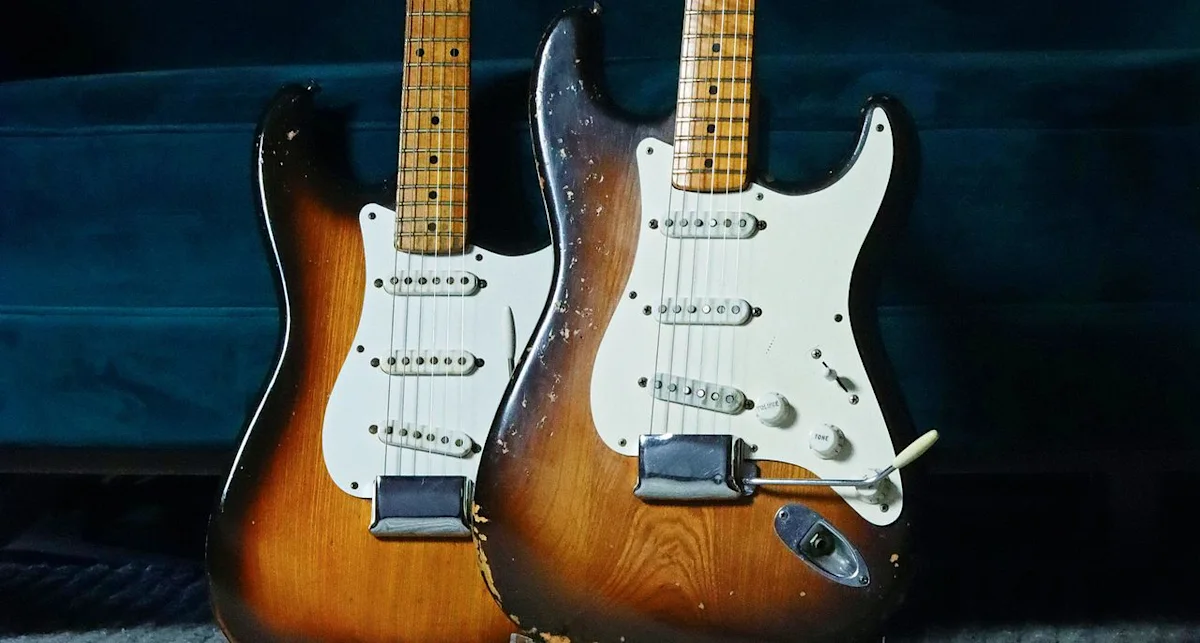
These early instruments are frequently quite heavy, with bodies constructed from multiple pieces of ash rather than the single-piece solid ash slabs Fender adopted later. The weight disparity between an early and late 1954 build can be as much as 3 pounds. While I have previously owned instruments dated January 1954, the earliest Stratocaster currently in my possession actually pre-dates the "0108" build by a couple of months.
While I have encountered early models featuring slot-head screws solely on the pickup selector or pickup height adjustment points, this specific guitar is the only one I have ever seen where every single screw throughout the entire instrument utilizes a slot-head design. The potentiometer date codes on "0108" indicate the 42nd week of 1953, and the bridge pickup cavity completely lacks the standard wire channel (commonly known as the "worm rout").
While Fender production staff later learned to cut this wiring channel efficiently using a rounded router bit, the earliest Stratocaster cavities were notched out by hand using a chisel. This guitar also features translucent short-lived polystyrene pickup covers, which age gracefully into a distinctive, cool greyish hue over time.
Additional early features include short skirt control knobs, circular string-access holes on the rear tremolo cover, and a football-shaped pickup selector tip. Having handled approximately 20 backplate-serial Stratocaster models throughout my career, I have consistently found that they produce a darker, bass-heavy acoustic and amplified character, particularly through the neck and middle pickup positions.
I would not describe these initial builds as sonically balanced as the refined late-1954 production guitars. Their early hand-wound pickups utilized softer Alnico III magnets featuring a shorter pole piece slug under the G-string. This darker tonal spectrum was also influenced by the 100k ohm potentiometers Fender installed on the earliest production run, prior to switching to standard 250k ohm pots.
The substantial body weight plays a major role in this voicing, much like how heavier Gibson Les Paul "Burst" models deliver a deeper, meatier growl compared to lighter examples. The overall body contours remain similar across 1954, though the rear belly cut contour is executed slightly deeper on the earliest builds.
By late 1954, Fender transitioned to predominantly single-piece ash bodies, including stunning quarter-sawn grain cuts. The white polystyrene covers were updated to a solid, non-translucent material alongside full skirt control knobs. The neck profile was reduced in bulk compared to early 1954 builds, and center-pocket tweed hardshell cases permanently replaced the early form-fit poodle cases.
The earliest tremolo arms featured a sharp bend near the tip, which was quickly smoothed out into a gentler angle before straightening further through the late 1950s and 1960s. Fender actively gathered player feedback by field-testing instruments with local country and barn-dance musicians, and the primary complaints regarding the first batch were undeniably the heavy body weight and the bulky neck carve. That initial deep U-shaped neck profile feels quite thick in the hand, and while vintage collectors treasure it, very few gigging players prefer it today.
By mid-1954, Fender introduced the hardtail bridge option. While many players assume hardtail models were introduced years later, Fender planned non-tremolo builds from the very beginning, intending to market the new Stratocaster directly to established Fender Telecaster players.
Not every guitarist required a vibrato system, and many favored hardtail builds for their superior natural sustain and punchy attack. While installing five tremolo springs and tightening the bridge plate flush against the body on a standard Stratocaster gets close, hardtail builds consistently exhibit a distinct sonic snap and resonance.
Both of these 1954 examples remain remarkably original. At some point in its history, a previous owner spelled out their name across the body of the early build using small finishing brads.
Although numerous tiny pinholes remain across the wood, they blend naturally into the vintage patina like routine play wear, leaving the original name a mystery. Over the years, we have also documented multiple 1954 Stratocaster units featuring an enlarged, elongated headstock truss rod plug.
While historians once believed these were custom modifications designed to match the early prototype Stratocaster seen in Fender promotional photos, current research confirms that factory workers frequently had to rework the truss rod access area during assembly, fitting a larger wooden plug or spraying dark lacquer around the headstock scoop to conceal factory adjustment work.
Guitar collectors consider early-1954 Fender Stratocaster models the absolute pinnacle of rarity due to their extreme scarcity. Fender produced only around 200 of these initial pre-standardization instruments, and the vast majority have been heavily modified or restored over time. The late-1954 model featured here is structurally identical to a 1955 model, as Fender had fully standardized the production specifications by August or September 1954. In terms of overall tone, dynamic response, and effortless playability, late-1954 Stratocaster builds represent the absolute gold standard of vintage electric guitars.