No Filler, No Reverb, No Mercy: 40 Years of Slayer's 'Reign in Blood'
Forty years later, this record remains a landmark that changed the sound, speed, and possibilities of the genre.
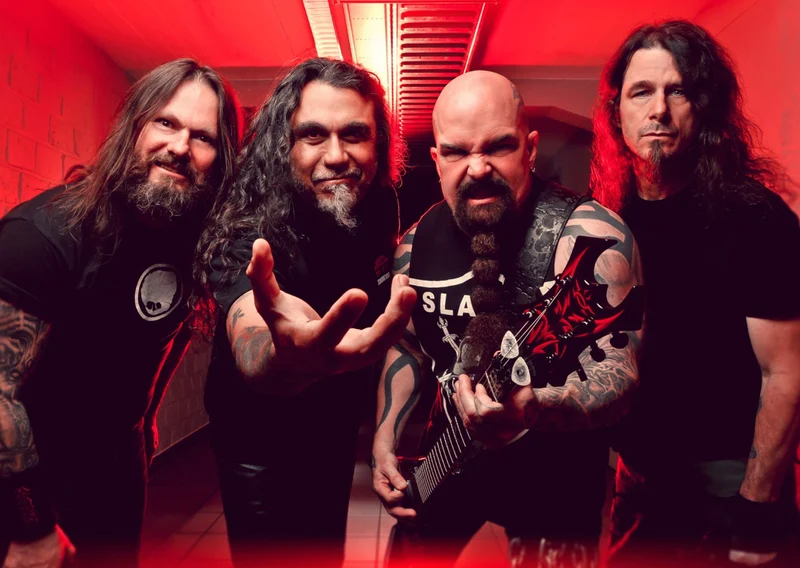
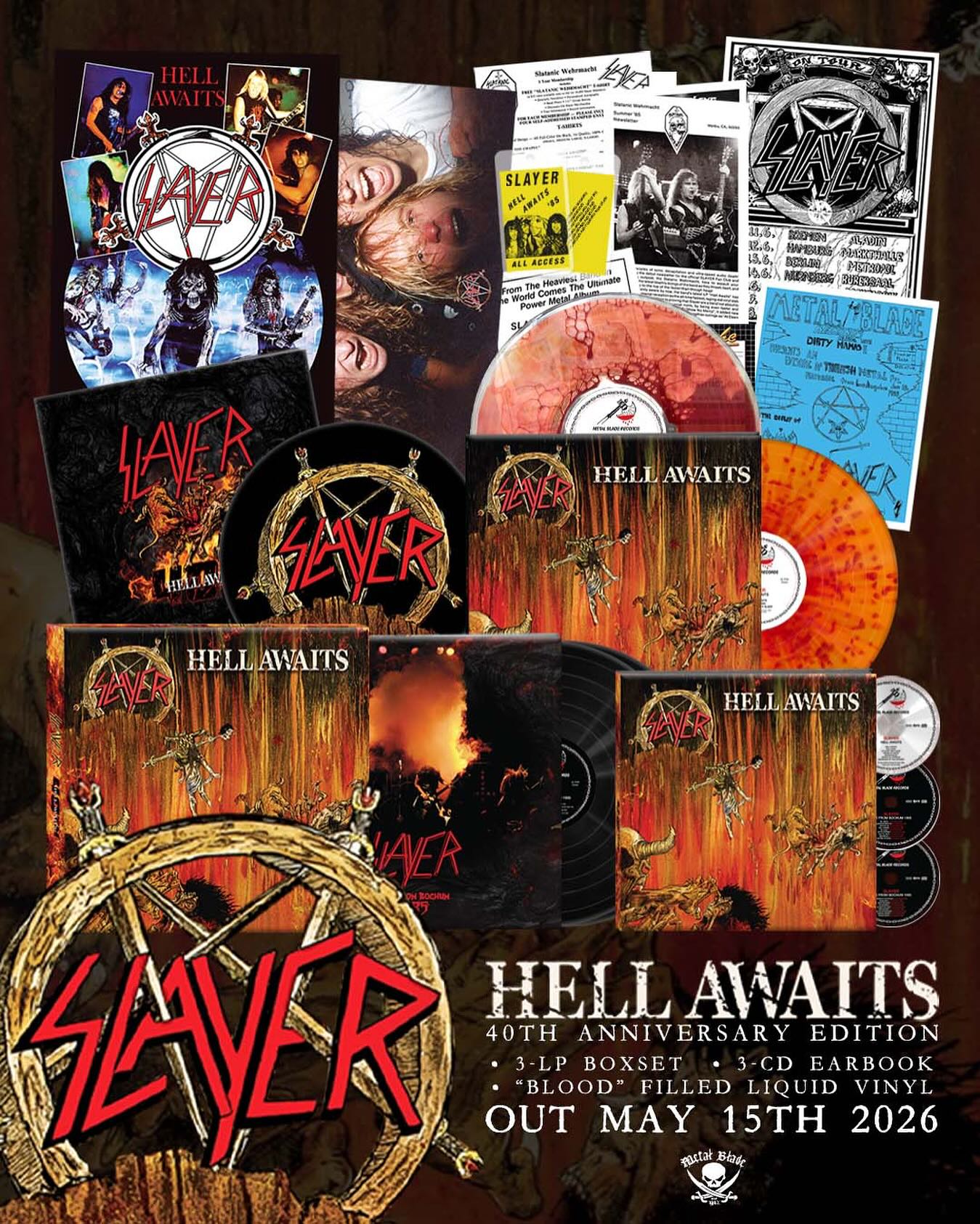
By the mid-1980s, thrash metal had a pecking order, and Metallica had risen to the top of it after signing to Elektra in 1984. Slayer had two albums out on the independent label Metal Blade, «Show No Mercy» and «Hell Awaits», and sat close behind, but as metal journalist Don Kaye wrote for Louder, nobody «really expected Slayer to get a major deal at the time because they were so heavy.»
Then came an unlikely match. Def Jam, the hip-hop label behind Run-DMC and the Beastie Boys, wanted the band, and its boss, Rick Rubin, went after them harder than any other suitor. The album that came out of that deal, «Reign in Blood», went on sale on Oct. 7, 1986, guitarist Kerry King telling Metal Hammer, «We never realized how special it was when we were working on it. We knew it was cool, but we never thought it was what people would talk about for the next 30 years.»
The ambition was deliberate. «We were getting cocky,» drummer Dave Lombardo recalled in an oral history for Louder. «We had already released two albums and been on tour.» Metal Blade owner Brian Slagel put the goal bluntly: «On 'Reign In Blood', I think that was the single focus: 'We want to make the fastest, heaviest record that's ever been done.'»
The new material came from a different place than the old. Guitarist Jeff Hanneman had bought recording equipment and started making demos, handing the band cassettes with drum patterns, riffs and arrangements already sketched out, and he had fallen hard for West Coast punk. «TSOL, Minor Threat, Dead Kennedys, Circle Jerks… Jeff was discovering new bands all the time,» Dave Lombardo said. «It was definitely a turning point.» Singer and bassist Tom Araya said the plan was never subtle. «Kerry and Jeff said that they didn't want to do a slow record; they wanted to do something fast. They didn't realise it was gonna be that fast…»
Rick Rubin had no metal background to speak of. He first saw Slayer at The Ritz in New York, he recounted in the same oral history, and «I knew nothing about them before the show, and they blew me away.» Kerry King's reaction to the connection was less certain: «Was I a fan of hip hop? I wasn't, no.»
The band went to Hit City West in Los Angeles with Rick Rubin and engineer Andy Wallace. Dave Lombardo remembers a modest room. «The studio was just a little place on Pico and La Cienega Boulevard. It wasn't elaborate.» His own work went quickly. «I believe I recorded my tracks in three or four days,» he said. «There were no computers, no software. It was well-rehearsed: get your tempo down, press record and don't fuck up.»
What changed the sound was subtraction. The band had leaned on heavy reverb for «Hell Awaits», and Jeff Hanneman later described the difference: «'Hell Awaits' had a kind of Wall Of Sound, Phil Spector, production. Rubin said, 'You don't need that. Without the reverb it'll be more in your face.'» Kerry King remembered the moment it clicked: «Somebody at some time said, 'You don't need reverb to be good.' Once we got that in our heads, we were like, 'OK, that's pretty fucking tight.'»
Rick Rubin worked as a fan with a theory and no metal habits to unlearn. In a 2024 interview with Rick Beato, he explained the thinking: «I didn't want it to be a blur of bass; I wanted it to be a pulse.» He added: «I was more subtractive than additive. It was getting back to the essence.» The one thing he asked for more of was menace. Rick Rubin's only concern, according to MusicRadar, was that the band had toned down the Satanic imagery of its first two albums, and at one point he demanded «More Satan!» «They were getting away from the roots,» he said, laughing. The same report quotes Jeff Hanneman on where much of the writing happened, at his girlfriend's parents' house: «When my girlfriend's dad came home at night we'd have three or four martinis, we'd play video games, and then I'd write in her bedroom.»
The ten songs cut the band's earlier sprawl down to essentials. «Angel of Death» opens the album at 4:51, and Jeff Hanneman wrote it after reading books about Josef Mengele during a tour. Dave Lombardo described the mood in a few words: «It was, 'Let's be brutal. Let's be evil, dark.' I thought it was great.» The closer came together at the last minute. Kerry King said he finished the lyrics for «Raining Blood» in the studio lobby: «I think Jeff was doing some of the tracks inside. He had no ideas for the part I was working on, so it was, like, 'Here, let me try. I finished it.'» Dave Lombardo's favorite stretch of the record is the move from «Postmortem» into «Raining Blood,» which he calls «monstrous» and says «it's epic how it flows from one song to the other.» The album ends with a full minute of rain sound effects.
The brevity surprised everyone, including the singer. «All 10 songs came in at 28 minutes,» Tom Araya said. «A full album, contractually, constitutes at least 45 minutes of music. I asked Rick if that was OK. His only reply to any of that was, 'It's 10 songs, which constitutes an album. There's verses and leads and choruses.'»
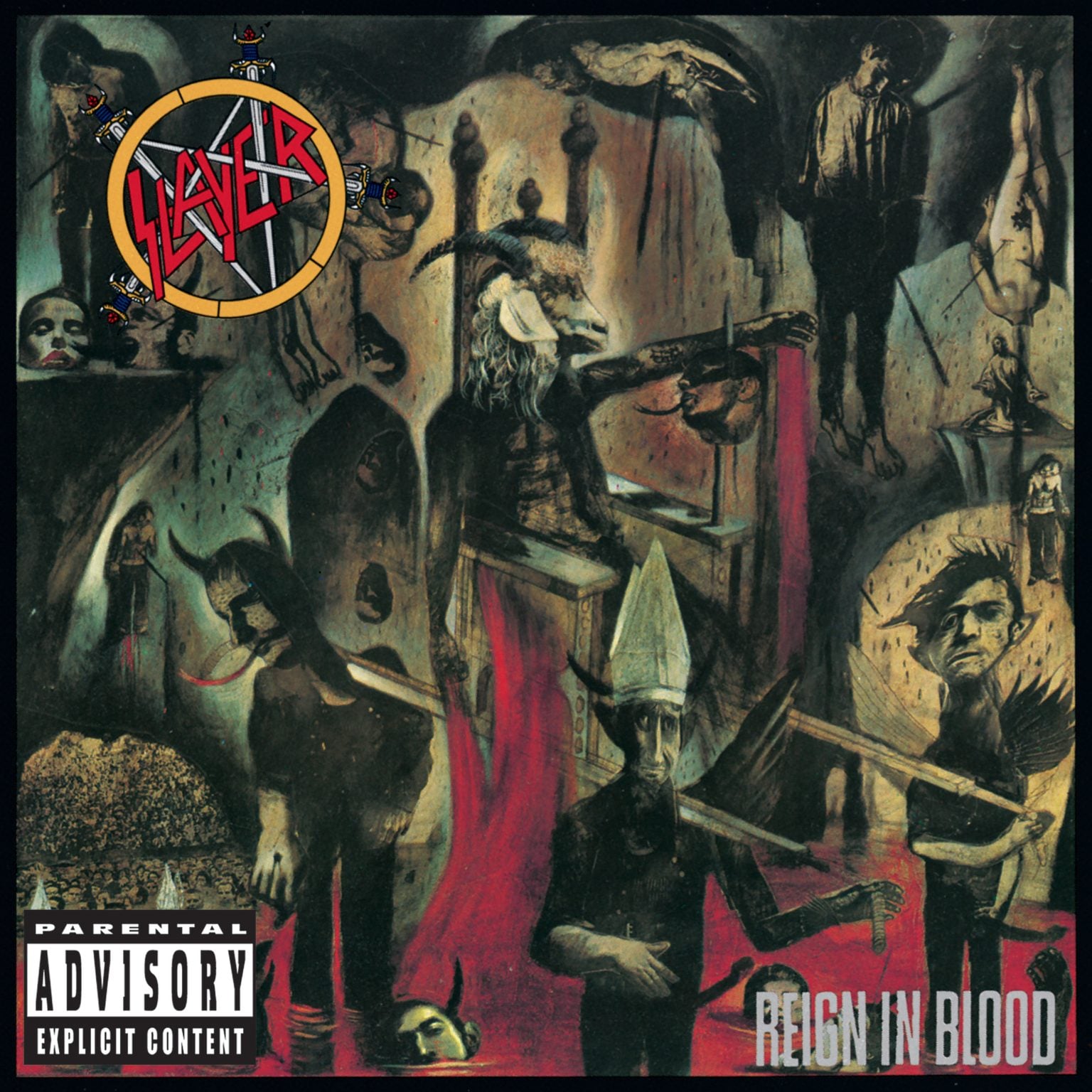
The cover was almost as confrontational as the music. Rick Rubin brought in Larry W. Carroll, a political illustrator whose work had appeared in The Progressive, The Village Voice and The New York Times, rather than a traditional heavy-metal album artist. «We needed to have an album sleeve that reflected what we were about,» Tom Araya said. «We weren't after our version of Iron Maiden's Eddie, but it needed to be striking.»
Carroll was given the music and lyrics and produced a grotesque, densely packed vision of hell: a demonic, goat-headed figure enthroned above a sea of severed heads, surrounded by distorted bodies and religious imagery. Carroll would go on to create the covers for «South of Heaven» and «Seasons in the Abyss», but «Reign in Blood» established the visual language that would become inseparable from Slayer: violent, occult, disturbing and deliberately difficult to look at.
Then the distributor weighed in. Def Jam's releases went out through Columbia, and Columbia president Walter Yetnikoff viewed «Angel of Death» as anti-Semitic and refused to release the album unless the opening track was pulled. The band declined. «All of a sudden, the record company doesn't want to release the album,» Tom Araya said. «We were, like, 'Fuuuuuck…'» Kerry King's memory is just as blunt: «I didn't know shit about the world at that point. I thought, 'That is the most ridiculous thing I have ever heard.'»
The album ended up with Geffen, which left its logo off the record and kept it off its release schedule. Dave Lombardo thinks the standoff helped. «We just followed Rick and what he wanted to do, and, sure enough, it did work to our advantage because it created a lot of mystery around the album. People were curious.» Metal journalist Don Kaye recalled that mainstream magazines largely ignored the band at the time, and that the only Rolling Stone coverage it received came when Columbia refused to distribute the album.
The band has repeatedly denied supporting Nazism, and Kerry King's rebuttal, quoted by Louder from a 2015 Loudwire interview, has stayed consistent: «My rebuttal to that has been since day one, if you put that on the History Channel and took Slayer out of it, it would be an educational, intriguing ride through World War II. You put Slayer in, and heavy metal, and it's, 'Oh, they meant that shit!'»
The record never got radio play. It debuted at No. 127 on the Billboard 200 and peaked at No. 94 in its sixth week, reached No. 47 in the U.K., and went gold in the U.S. on Nov. 20, 1992. Slagel's first reaction was simple: «This was pretty much just pounding your head in for 29 minutes.»
On stage it landed hard. The tour began on Halloween 1986 at The Moore Theater in Seattle, with Overkill opening. Overkill singer Bobby «Blitz» Ellsworth remembered the welcome: «We came out in front of Slayer to a hail of wet paper towels, Zippo lighters and coins thrown at us.» Dave Lombardo described the aftermath of the headline sets: «They would clear the venue and you'd take a walk through afterwards and there'd be pools of blood.» He left the band late that year, and Rick Rubin called him daily, offered a salary, and eventually picked him up in his Porsche to take him to a rehearsal when he returned in 1987.
What made «Reign in Blood» so startling wasn't simply how fast the songs were. Very little stood between the listener and the band. The guitars were brutally dry, the drums sounded immediate rather than buried in studio effects, and the arrangements left almost no room to breathe. There was no grand buildup and no attempt to make the violence sound polished. The record simply arrived at full speed and stayed there.
The album's reputation grew from there. Decibel inducted it into its Hall of Fame in November 2004 as the first album, and Kerry King has a cooler explanation for why it lasted. He told Kerrang!: «If you released 'Reign in Blood' today, no one would give a shit. It was timing; it was a change in sound. In thrash metal at that time, no one had ever heard good production on a record like that. It was just a bunch of things that came together at once.» Kaye said it «didn't feel so much like an evolutionary step as setting a new bar for everything that was going to follow,» and Slagel said it «took extreme and super-heavy metal out to the mainstream kids. It led the way for Pantera and so many other bands who had success.»
But its lasting power transcends influence and the thousands of musicians who followed. Dave Lombardo hears something more personal when people talk about the album. «Although the music may have been intense and violent, people have told me that it's helped them navigate the most horrible times of their lives. That's just special.» For all the talk about speed, heaviness and brutality, that may be the most revealing measure of «Reign in Blood»'s staying power.
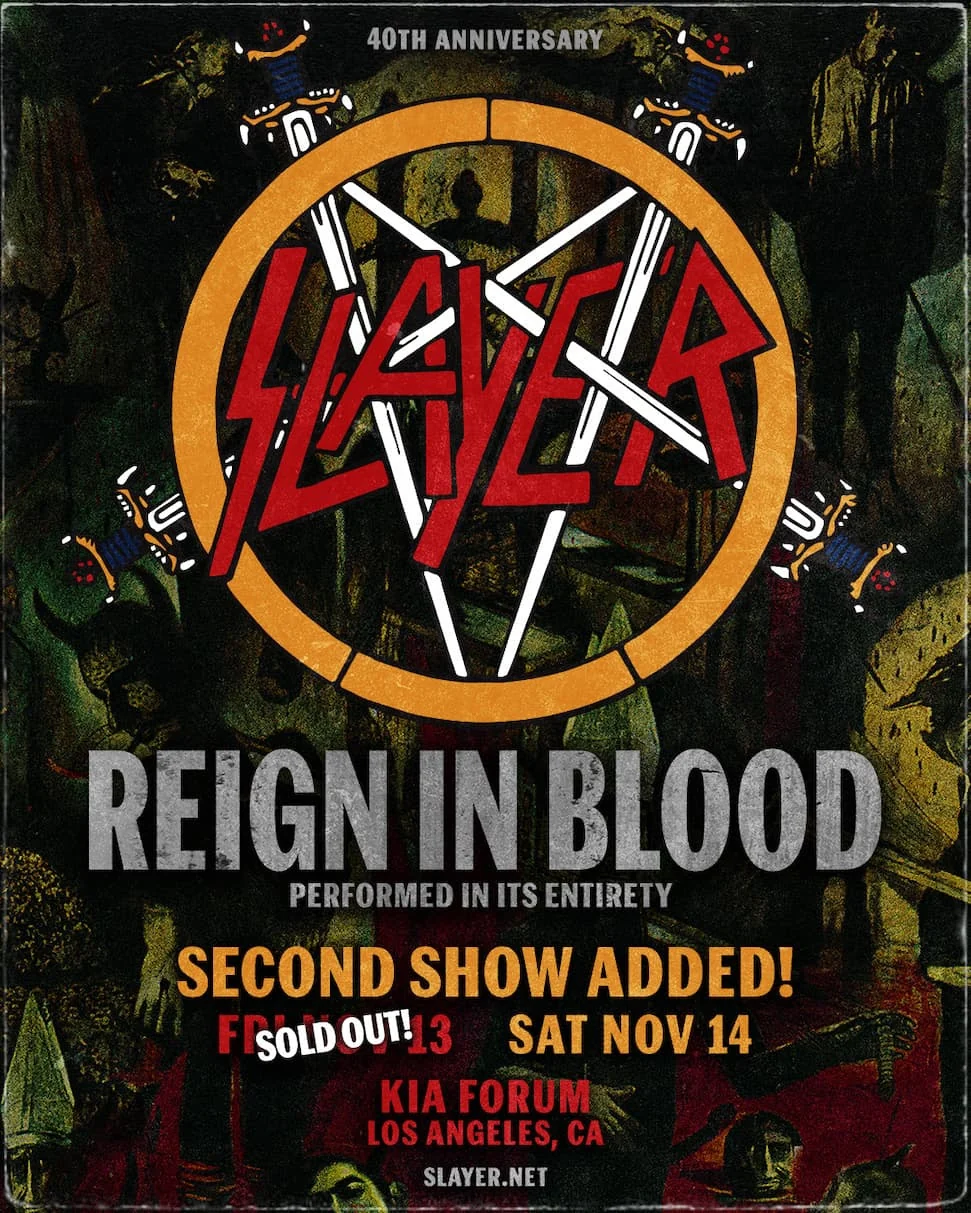
This fall, the band is marking the anniversary on stage. Slayer retired from touring in 2019 and reunited in 2024. After playing the album in full in Shakopee, Minn., on Sept. 4, their first complete performance of it since 2014, they will do it again on a Latin American run that begins in Mexico City on Oct. 21 and at the Kia Forum in Inglewood, Calif., on Nov. 13 and Nov. 14, their first Los Angeles shows in seven years.
Forty years later, «Reign in Blood» still sounds less like a record from 1986 than a warning that somehow never stopped being relevant. Its influence is everywhere, but its impact is harder to quantify: ten songs, 29 minutes, no wasted motion, and a production style that stripped heavy metal down to its most violent essentials. Slayer set out to make the fastest, heaviest record they could. They may not have known it at the time, but they also made one that refused to age. The album is over almost before you can catch your breath, and that may be the most Slayer thing about it.